

How to Handle a 40% Volume Spike Without Adding Headcount
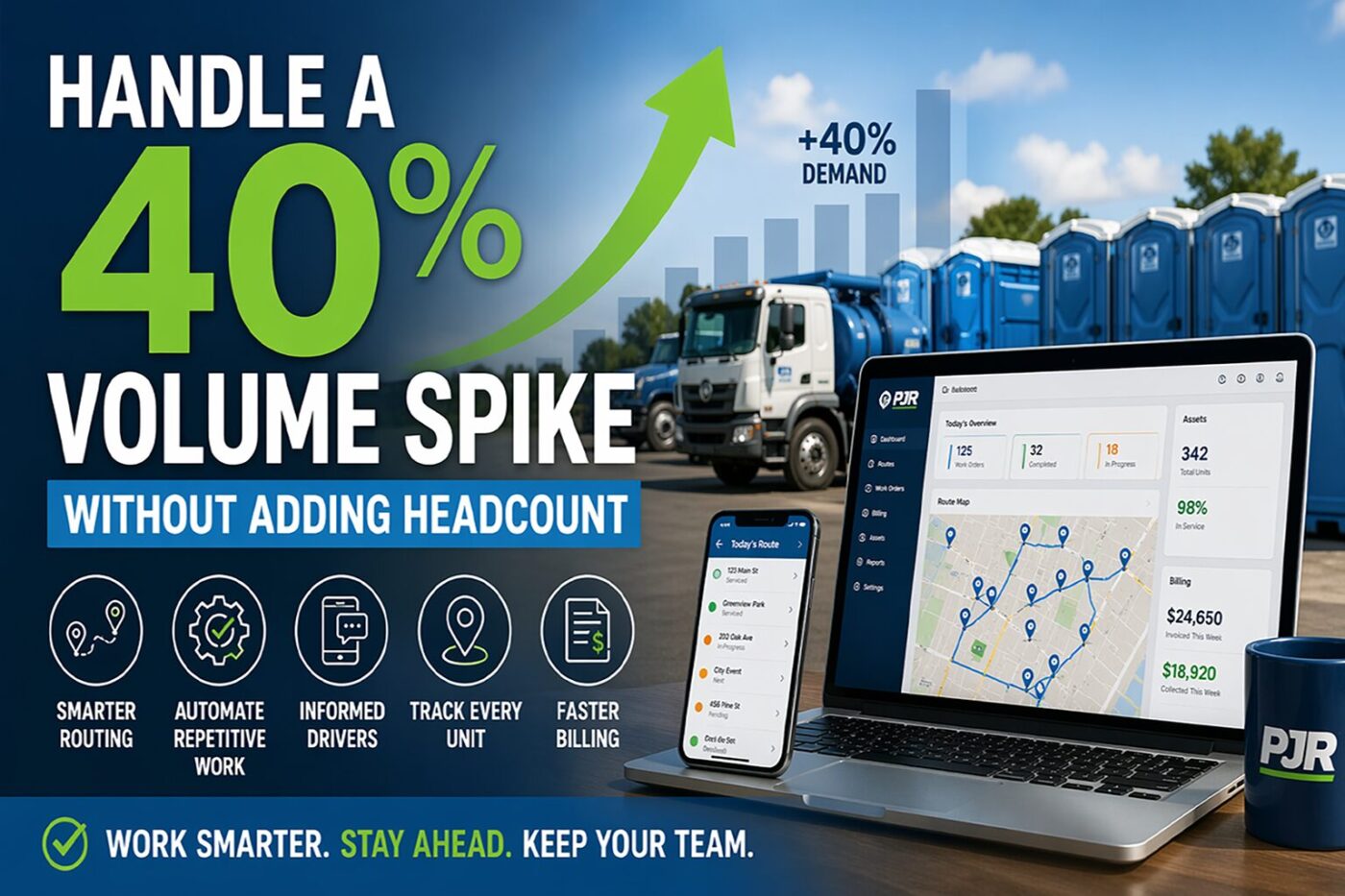
Every spring it happens. The phones start ringing more. Jobsite calls stack up. Event requests come in back-to-back. And somewhere around mid-May, you look up from your desk and realize — you’re in it now.
Peak season in portable sanitation doesn’t sneak up on you. You know it’s coming. But knowing it’s coming and being ready for it are two very different things. The operators who stay sane during a 40% volume surge aren’t necessarily the ones with the biggest crews — they’re the ones who’ve built smarter systems.
Here’s how to handle the rush without burning out your team or hiring people you’ll have to let go in November.
1. Stop Managing Routes in Your Head (or on Paper)
This is where most small operators start to crack under pressure. When volume jumps, the mental load of routing becomes overwhelming — especially if you’re still piecing together daily runs based on memory, sticky notes, or a whiteboard.
The operators who handle surge best have one thing in common: their routing is automated and optimized. Not “I put the stops in Google Maps” optimized — actually optimized, with software that accounts for geography, ticket type, service frequency, and driver availability.
With a tool like PJR’s AI route optimization, what used to take an hour of dispatch planning in the morning gets handled in minutes. Your drivers hit the road faster, cover more stops per day, and don’t have to double back across town because two similar jobs were scheduled on opposite routes.
When volume spikes 40%, you don’t need more drivers — you need the drivers you have running tighter routes.
2. Get Repetitive Work Off Your Plate
During peak season, the work that piles up fastest isn’t the physical service — it’s everything around it. Confirmations. Invoices. Customer follow-ups. Scheduling changes. If your team is handling all of that manually, they’re spending hours every day on admin instead of on revenue-generating work.
Think about what happens every time a new rental order comes in. Someone has to enter it, schedule it, confirm it with the customer, assign it to a driver, then invoice it when the service is done. If that chain has five manual steps, multiply that by your volume increase and you’ll see the problem fast.
The businesses that scale without adding headcount have automated the repetitive parts — auto-scheduling, auto-invoicing, customer notifications — so the only thing humans are touching is the exception, not the rule.
3. Give Your Drivers Information, Not Phone Calls
Here’s a scenario most PROs know well: a driver calls in during a route because they can’t find a unit, or they’re not sure if a stop is a service or a pickup, or the customer changed their delivery address and no one told them.
Every one of those calls pulls someone off of what they’re doing. And during peak season, those interruptions stack up fast.
When drivers have a mobile app with their full job details — stop-by-stop, with notes, photos from previous visits, and real-time updates — they don’t need to call. They have the information. PJR’s driver app does exactly this, keeping the field and the office in sync without constant back-and-forth. Fewer calls means fewer interruptions means more stops per shift.
4. Know Where Every Unit Is
Asset tracking becomes critical when volume surges. The more units you have in the field, the harder it is to keep track of where everything is — especially if you’re running events, construction sites, and regular service routes at the same time.
Operators who struggle during peak season often find themselves doing emergency “where is that unit?” searches that eat up time and occasionally cost them a customer. Operators who have clean, up-to-date inventory tracking in their software always know where their assets are, which ones are due for service, and which customer has had a unit sitting longer than agreed.
It’s not glamorous, but knowing where your stuff is in real-time is one of the most underrated advantages during a busy stretch.
5. Let Your Software Handle the Billing While You Handle the Business
Cash flow matters most when you’re busiest — ironically, that’s also when invoicing tends to slip. Jobs get done but don’t get billed right away. Invoices go out late. Customers pay slow because the paperwork wasn’t clean.
Automating your billing cycle so that invoices go out as soon as jobs are completed — not at the end of the week when someone finally gets to it — keeps money moving. PJR’s billing system ties directly to completed service tickets, so there’s no lag between the work being done and the invoice being sent.
During a volume spike, that timing difference can mean the difference between a healthy cash position and a stressful one.
The Bottom Line
You don’t need to double your headcount to handle double the work. What you need is a system that scales with you — one that routes smarter, automates the repetitive stuff, keeps your drivers informed, tracks your assets, and invoices without delay.
The operators who thrive during peak season aren’t working harder than everyone else. They’re working with better tools.
If your current setup has you feeling the strain every spring, that’s a signal worth paying attention to — even if now isn’t the moment to make a change. File it away. Because when the season slows down, the smartest move you can make is setting yourself up to never feel that strain again.
PJR Software is built for portable sanitation and waste service operators who want to run leaner, smarter, and more profitably. Request a free demo and see how it handles your busiest days.
