

Your Busiest Season Is Exactly the Right Time to Re‑Evaluate Your Software
Peak season in the portable sanitation and waste services industry doesn’t leave much room to breathe.
Routes are full. Phones are ringing nonstop. Drivers are stretched. Equipment is moving. Customers want answers now—not later. Whether you service septic tanks, manage roll‑off containers, operate porta potties, or haul waste, one thing is almost guaranteed:
The busy season exposes what’s working—and what’s quietly costing you money.
Ironically, the most demanding time of year is also the clearest moment to evaluate whether your current software is helping you—or holding you back.
Why Busy Season Is the Best Time for Honest Comparison
When operations slow down, inefficiencies hide. During peak demand, they show up everywhere.
Busy season answers critical questions automatically:
- Are dispatchers jumping between spreadsheets, whiteboards, texts, and calls?
- Are drivers calling in because routes aren’t optimized or updated?
- Are tickets, invoices, or missed services delaying cash flow?
- Are temporary workarounds becoming permanent habits?
If you’re using software today, this season reveals:
- What features you actually use
- What you wish worked differently
- What slows the team down during pressure moments
If you’re not using software at all, busy season highlights even more:
- Time lost to manual scheduling
- Revenue leakage from missed or delayed billing
- Stress placed on staff that doesn’t scale
Comparison doesn’t require switching right now.
It simply requires paying attention.
If You’re Using Software: Measure It Against Reality, Not Promises
Most operators didn’t choose their current system lightly. But many systems were adopted years ago, before mobile-first tools, route optimization, or real-time visibility became essential.
Ask yourself:
- Does this software reduce day-to-day friction—or add steps?
- Can new drivers and dispatchers learn it quickly during peak season?
- Does it support septic pumping, roll-offs, recurring sanitation routes, or all three?
- Does it scale with seasonal demand—or struggle under volume?
Busy season gives you real data:
- How long dispatch takes
- How often mistakes occur
- How fast invoices go out
- How many manual overrides are required
That data becomes your benchmark.
If You’re Not Using Software: Why Starting Now Still Makes Sense (Without Disruption)
Let’s be clear: busy season is not the time for a full system overhaul.
But it is the time to:
- Document your current workflows
- Identify repetitive tasks that drain time
- Understand the true cost of inefficiency
Starting your evaluation now means:
- You’re not scrambling during the off‑season
- You avoid rushed decisions
- You’re ready to move when timing is right
Even limited use—like digital routing, job tracking, or billing visibility—can uncover immediate opportunities to:
- Reduce overtime
- Prevent missed or duplicated services
- Get paid faster
A Practical, Low‑Distraction Software Readiness Roadmap
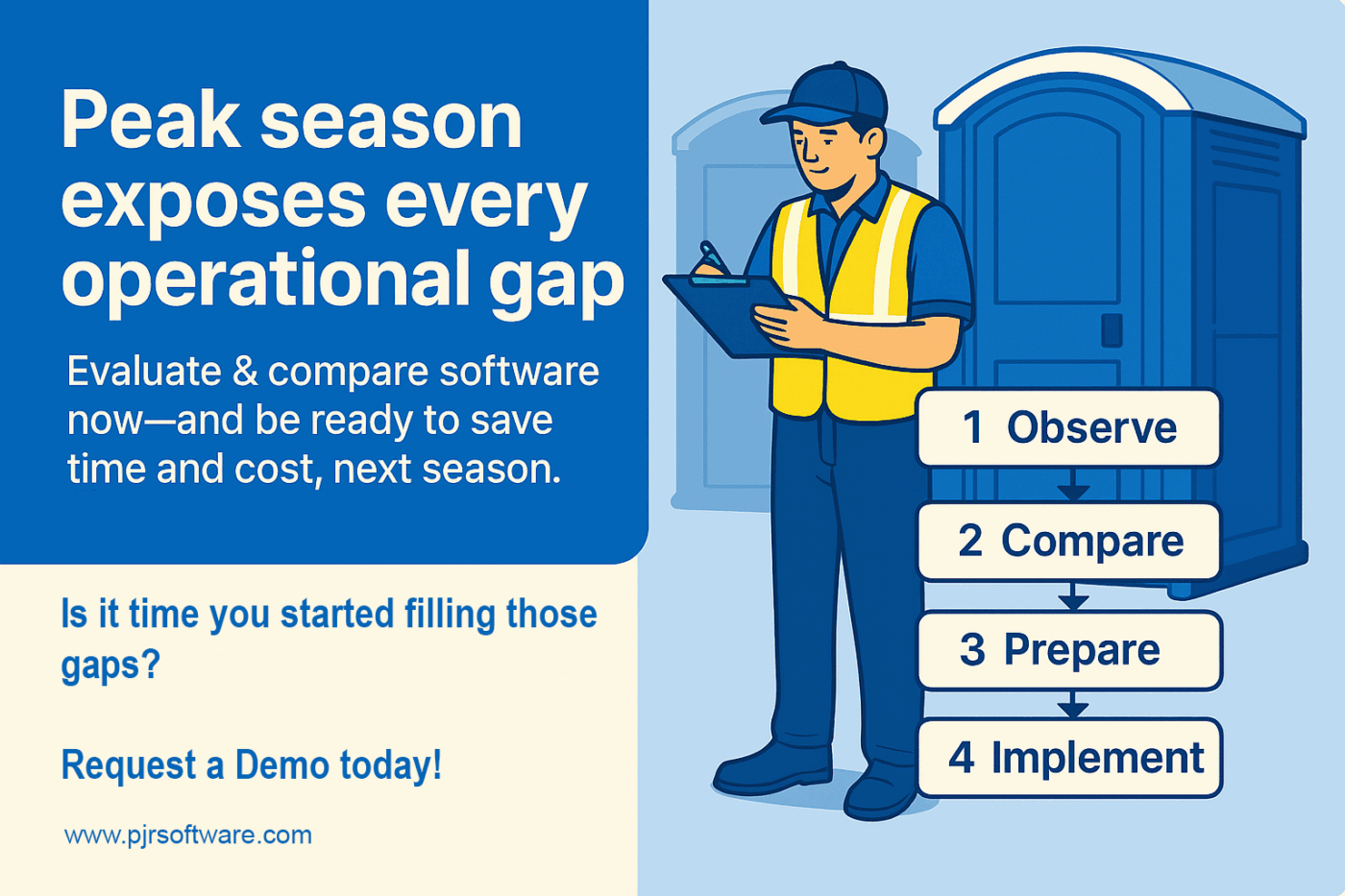
Here’s a season‑safe roadmap designed for sanitation, septic, roll‑off, and hauling companies—focused on preparation first, implementation later.
Phase 1: Observe (During Busy Season)
No changes. No disruption.
- Track where time is lost daily (dispatch, paperwork, callbacks)
- Note peak‑day pain points
- Identify features you wish existed, not just what you tolerate
 Outcome: Clear operational priorities
Phase 2: Compare Quietly (Late Busy Season / Early Off‑Season)
- Compare your workflow against modern industry‑specific software
- Look for solutions built for containers, routes, assets, and recurring service
- Involve dispatchers—not just leadership
Outcome: Shortlist of tools that fit your business reality
Phase 3: Prepare (Off‑Season)
- Clean customer, asset, and pricing data
- Standardize service types and rates
- Identify one or two processes to improve first (not everything)
Outcome: Reduced implementation time and lower costs
Phase 4: Implement Strategically (Before Next Peak)
- Roll out in phases (dispatch → drivers → billing)
- Train with real routes and equipment
- Avoid custom workarounds until basics are mastered
Outcome: Software that supports growth instead of disrupting it
How the Right Software Saves Money—Even If You Wait to Implement
Preparation alone can:
- Reduce poor purchasing decisions
- Prevent costly change orders or customizations
- Shorten onboarding time
- Lower training costs
- Improve staff retention by reducing stress during peak demand
When done right, implementation happens before the next busy season, not in the middle of it—so your operation enters peak demand stronger, calmer, and more profitable.
The Mission: Make Busy Season Easier—Not Just Survivable
Portable sanitation, septic service, roll‑off, and waste hauling companies are essential businesses. The work is physical, time‑sensitive, and often invisible until it’s not done well.
The mission of better software isn’t to add complexity—it’s to:
- Give operators clarity
- Give dispatchers control
- Give drivers confidence
- Give customers consistency
Busy season already shows you what matters.
Use it. Learn from it. Prepare—without pressure.
Because the goal isn’t just to survive this season.
It’s to be ready for the next one—better than ever.
